7 Best Manager Coaching Software in 2026
Your managers are getting feedback once a quarter and coaching the other 89 days. That gap shows up as stalled one-on-ones, vague performance reviews, and employees who leave before anyone notices they are disengaged. Most teams start shopping for coaching software after a platform stops fitting how their managers actually work.
This guide breaks down the criteria that separate real manager coaching tools from glorified survey apps, then reviews seven options with pricing and key features, including HeyRamp, our pick for best overall. By the end, you will know which tool fits your team size and workflows, and how to make a confident choice.
What to Look For in Manager Coaching Software
Selecting the right manager coaching software requires evaluating features that align with your organization's coaching culture, performance goals, and integration needs. The market in 2026 is crowded, and many platforms look similar in a demo. The differences show up in daily use, when managers need to run a one-on-one, log feedback, or check progress on a team goal.
Start with the coaching behaviors you want to strengthen. If your managers struggle to hold consistent one-on-one meetings, prioritize tools with strong agenda builders and action tracking. If feedback is sporadic, look for continuous feedback and lightweight check-in features that fit into existing workflows rather than adding another destination.
Then consider how the software fits your HR technology stack. A platform that connects to your HRIS, chat, and calendar tools reduces manual work and improves adoption. A standalone tool that requires duplicate data entry tends to fade after the pilot phase.
Finally, weigh scalability and administration. A tool that works for a 20-person pilot may strain under thousands of managers across regions. Ask how permissions, reporting lines, and content localization are handled before you commit to a long contract.
Key Features and Evaluation Criteria
When evaluating manager coaching software, prioritize these core capabilities: structured 1-on-1 meeting tools with agendas and action tracking, goal and OKR alignment, continuous feedback mechanisms, and skill assessment frameworks. Use the checklist below to score each vendor against your priorities.
- One-on-one meeting tools: Shared agendas, reusable templates, note capture, and action item tracking with follow-up reminders.
- Goal tracking and OKRs: Cascading goals, progress dashboards, and visibility into how individual work connects to team objectives.
- Continuous feedback and engagement surveys: Quick feedback capture, pulse checks, and sentiment trends that flag manager effectiveness issues early.
- Skill assessment and learning: Competency frameworks plus connections to learning management systems or microlearning content for employee development.
- AI coaching and conversation templates: Suggested talking points, coaching workflows, and draft action plans that help less experienced managers run better conversations.
- People analytics and reporting: Dashboards showing meeting cadence, feedback frequency, goal progress, and adoption by team.
- Integrations: Slack integration, Microsoft Teams, calendar sync, Salesforce, Workday, and BambooHR or other HRIS integration options.
- User interface and ease of use: Low training burden for managers and a clean experience for remote coaching and video coaching scenarios.
- Pricing models and free trial: Per-seat versus tiered pricing, pilot options, and how costs scale as you add managers.
- Security and compliance: Data residency, role-based access, single sign-on, and audit logging.
Score each criterion on a simple scale, such as one to five, and weight the items that matter most to your program. A team focused on performance management may weight goal tracking and analytics heavily, while a leadership development team may weight AI coaching and skill assessment higher.
Run a short pilot with real managers before signing. Watch whether people return to the tool between scheduled meetings, since sustained use is the clearest signal of fit. Confirm that conversation templates and action plans match your management style, and check that reports give HR and team leads the visibility they need without extra spreadsheet work.
1. HeyRamp - Best Overall
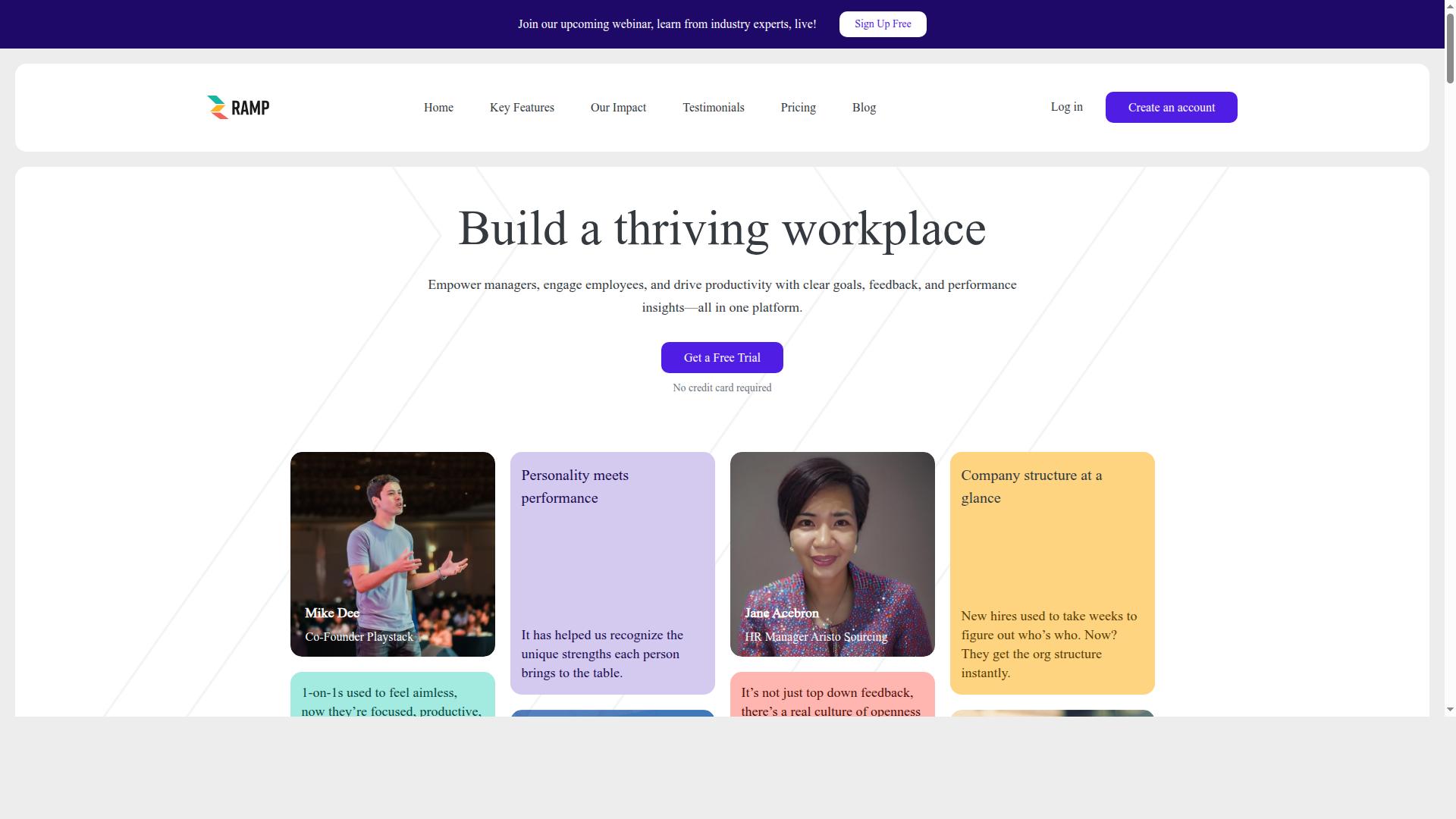
HeyRamp earns the top spot for its all-in-one platform that combines feedback, reviews, and team development. It is trusted by 20+ organizations and 400+ teams, which speaks to how well it fits real management routines.
What sets it apart is the combination of one flat fee pricing, built-in training and education, automatic compliance documentation, and personality insights tied directly to performance tools. Managers can start coaching without a long implementation project.
For teams comparing manager coaching software in 2026, HeyRamp offers a rare mix of breadth and simplicity. The sections below break down the pricing and the features that matter most.
Pricing and Key Features
HeyRamp offers transparent pricing at $5 per seat per month (billed monthly) or $3 per seat per month (billed annually), with custom enterprise pricing and a 14-day free trial requiring no credit card. Full access is available from day one, and teams can switch plans anytime as headcount or needs change.
| Plan | Price | Billing |
|---|---|---|
| Monthly | $5.00 per seat | Paid monthly |
| Yearly | $3.00/mo per seat | Paid annually |
| Enterprise | Custom pricing | Paid per seat |
That flat structure keeps budgeting predictable, an advantage over pricing models that charge extra for individual modules. A single per-seat rate covers the full platform rather than a stripped-down tier.
The feature set covers the core of manager coaching software and more:
- Company structure visualization so managers understand reporting lines and team context
- 1-on-1 meeting tools with organized agendas and action tracking
- Personality insights and testing woven into performance conversations
- Performance reviews, OKR and goal management, and real-time progress visualization
- Guided conversation templates, coaching tips, and sentiment prompts
- Automated reminders, KPI snapshots, and people analytics dashboards
- Compliance documentation with time-stamped secure records
- Built-in training videos for 1-on-1s, performance reviews, and personality testing
The built-in training and education support leadership development without a separate learning management system. Combined with automatic compliance documentation, the platform reduces the administrative load that often stalls employee development programs.
Small teams start on a monthly plan, and growing organizations can move to annual or enterprise pricing as adoption expands. The platform is designed for managers rather than analysts, which helps drive consistent usage across remote and in-office teams alike.
2. Lattice
Lattice is a well-established performance management platform known for its goal tracking, OKR features, and continuous feedback tools. It has grown from a reviews-focused product into a broader HR software suite aimed at HR leaders, managers, and People Teams.
The platform positions itself as "The industry leader in HR software" and bundles several connected modules under one roof. For organizations that want performance, engagement, and development data living side by side, that consolidation is a genuine draw.
Below is a look at where Lattice stands out, where teams tend to feel friction, and which use cases fit it best.
Strengths in performance reviews and feedback. Lattice's Performance product covers performance reviews, talent reviews, performance improvement plans (PIPs), and succession planning. It also supports 1:1s, Updates, and Feedback, which gives managers a single place to run one-on-one meetings and log continuous feedback between formal cycles. For manager coaching workflows, that means conversation history and review outcomes stay connected rather than scattered across documents.
Goals, OKRs, and development. The dedicated Goals & OKRs module handles goal tracking and alignment, while Grow supports career progression conversations. Compensation helps teams align pay with budget. Together these pieces support employee development and leadership development programs that need structure beyond an annual review.
Engagement and analytics. Lattice's Engagement product runs surveys with AI insights, and the platform includes Analytics and Habits alongside its core modules. Lattice AI includes an AI Agent described as "Your always-on HR partner," plus supporting capabilities such as MCP and integrations. An ROI Estimator is also offered for teams building a business case.
Common use cases. Lattice tends to fit organizations that want to:
- Replace manual review cycles with structured performance management workflows
- Connect OKRs to review outcomes and development plans
- Give managers reusable conversation templates and feedback tools for 1:1s
- Pair engagement survey data with people analytics for manager effectiveness
- Consolidate several HR point tools into one HR technology stack
Limitations to weigh. The breadth that makes Lattice attractive can also add complexity. Buyers often need to scope which modules they actually need, and pricing models that span multiple products can be harder to compare than single-purpose tools. Public pages do not state pricing, so teams should request a quote and map costs to modules in use.
There is also a learning curve for admins configuring review cycles, OKR structures, and survey logic. Smaller teams without a dedicated People Operations function may find the setup heavier than expected. As with any platform, feature details and packaging can change, so confirm current capabilities during evaluation.
Where it fits in a coaching stack. Lattice is strongest as the system of record for reviews, goals, and feedback rather than a lightweight coaching add-on. Teams evaluating manager coaching software in 2026 should check how well it supports action plans, progress dashboards, and skill assessment for managers specifically, and whether HRIS integration with systems like Workday or BambooHR meets their data needs.
3. 15Five
15Five focuses on continuous performance management with regular check-ins, engagement surveys, and manager coaching tools. It is built for managers and HR professionals who want employee development to happen in small, steady steps rather than in one annual review.
The platform's centerpiece is the Weekly Check-In, a short structured update where employees share progress, blockers, and wins. Managers respond in the same thread, which turns routine status reporting into an ongoing coaching conversation.
Around that core, 15Five layers in several related modules:
- High Fives for peer-to-peer recognition and public praise
- Private Feedback for sensitive input between a manager and a direct report
- 360 Degree Reviews and self-assessments with customizable templates
- OKR management covering goal setting, progress tracking, and alignment visualization
That combination covers continuous feedback, formal reviews, and goal tracking in one place. Teams that dislike stitching together separate feedback tools and OKR spreadsheets may find the bundled approach appealing.
The OKR and alignment features are worth noting for leadership development. Managers can see how individual goals ladder up to team and company objectives, which makes prioritization discussions in one-on-one meetings more concrete.
15Five is often a good fit for remote and distributed teams. Written check-ins give quieter employees a regular channel to raise concerns, and managers get a consistent record of how each person is doing week to week.
The product's stated emphasis on coaching conversations matters here. Rather than only scoring performance, it prompts managers to respond, recognize, and follow up, which supports manager effectiveness over time.
On reception, Appvizer rates 15Five 4.5 based on over 200 reviews, a solid signal of user satisfaction. Pricing details are not clearly published in the sources reviewed, so buyers should confirm current plans and costs directly.
Exact feature sets can also vary by tier and change between releases. Treat the list above as a general guide and verify specifics during a trial or demo before committing.
4. Culture Amp
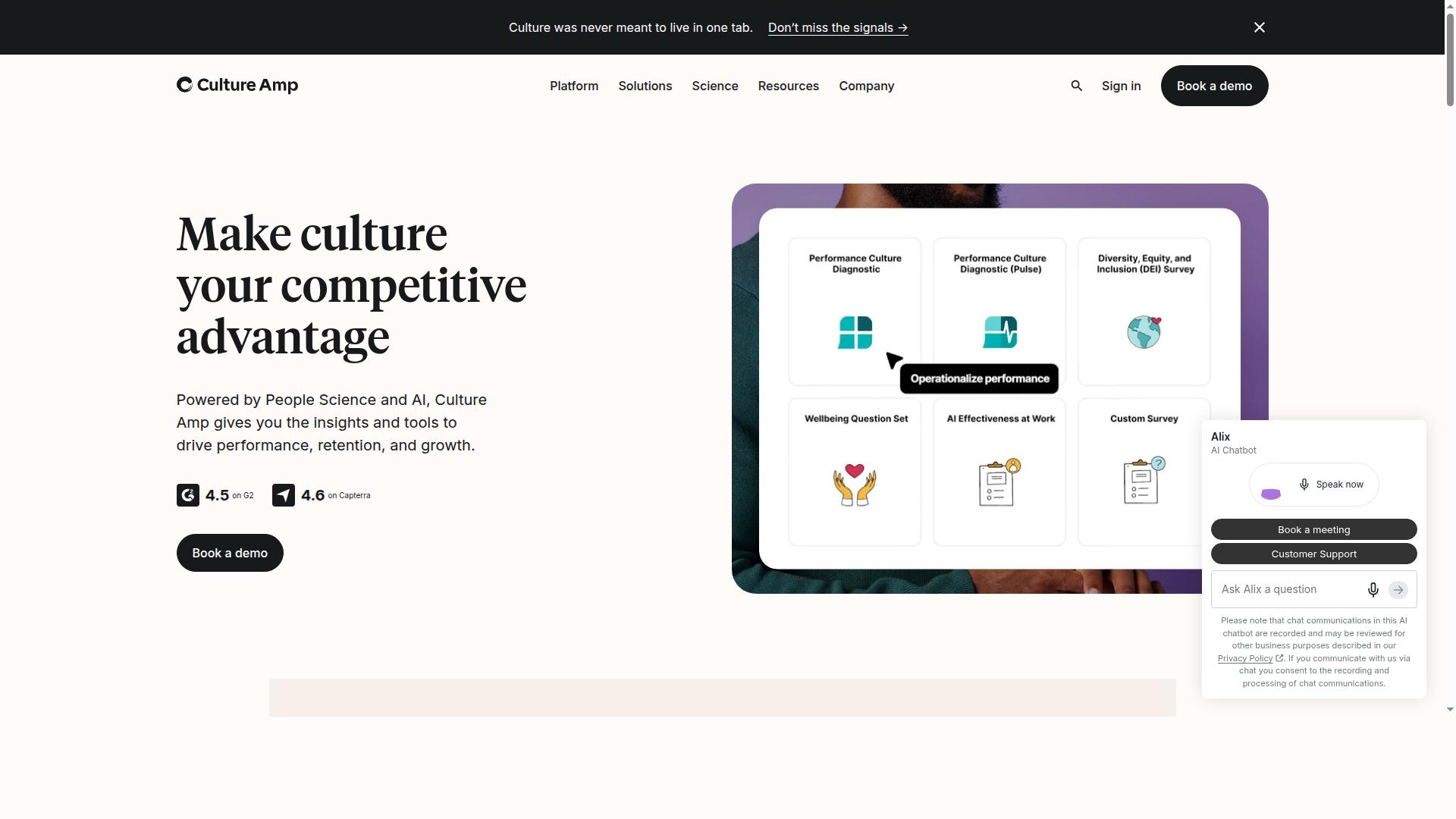
Culture Amp specializes in employee engagement surveys and people analytics, with performance management capabilities that support manager coaching. It is widely used by organizations pursuing culture transformation, and its survey engine gives managers structured feedback they can act on.
Where many tools in the manager coaching software category focus on the conversation itself, Culture Amp starts upstream with how employees actually feel. That makes it a strong fit for teams that want coaching grounded in real engagement data rather than manager intuition alone.
The Engage product is the platform's centerpiece. It includes ready-to-use surveys, pulse surveys, onboarding and offboarding surveys, and a DEI survey. Retention insights and AI comment summaries help managers scan large volumes of open-text feedback quickly.
Engage also offers proven action plans and benchmarking, plus a Performance Culture Quadrant that maps teams against culture dimensions. For leadership development programs, these views give managers a shared language for discussing team health.
The Perform module covers the coaching workflow more directly. It includes continuous feedback, performance reviews and calibration, one-on-one conversations, goal management, and employee development plans. A skills coach and AI Coach round out the manager-facing side, along with shoutouts and performance insights.
Managers can use these pieces to run more consistent one-on-one meetings and track progress against goals. The combination of feedback tools and development planning supports ongoing employee development rather than a once-a-year review cycle.
Culture Amp tends to suit organizations that want deeper engagement, survey, and culture analytics alongside performance management. Public comparisons note strengths such as a customizable platform and robust DEI analytics. Teams weighing it against other options should consider whether survey depth or conversation-level coaching is their priority.
- Best for: culture transformation programs and engagement-led coaching
- Standout areas: survey design, benchmarking, people analytics, DEI insight
- Coaching features: continuous feedback, one-on-ones, skills coach, AI Coach
- Consider if: you want manager effectiveness tied to engagement data
Pricing is not published in the sources reviewed here, so buyers should request a quote and confirm how survey and performance modules are bundled.
5. Betterworks
Betterworks is designed for goal alignment and OKR management, helping managers track progress and provide continuous feedback. It sits firmly in the enterprise tier of manager coaching software for 2026, built around what the vendor calls continuous performance management.
That means structured goal-setting, regular progress check-ins, manager conversations, and formal performance calibration all live in one system. Teams that already run on OKRs will recognize the model immediately.
The platform connects daily work to company strategy through cascading goals. Managers can set objectives from the company level down to individual contributors, then watch alignment take shape through visual alignment mapping.
This makes it easier to spot orphaned goals or teams pulling in different directions. For leadership development and performance management at scale, that visibility is the core value proposition.
Betterworks supports the full coaching loop, not just goal tracking. Managers get continuous check-ins and configurable performance reviews, so feedback happens between cycles rather than only at year end.
- Company-to-individual OKR setting with alignment visualization
- Continuous check-ins and manager conversations
- Configurable performance reviews
- Calibration workflows, including 9-box grids and calibration sequences
- AI-generated goal suggestions and automated progress nudges
- AI-assisted review writing
Those AI features fit the broader 2026 shift toward AI coaching platforms, though here they lean toward goal hygiene and review drafting rather than live conversational coaching.
Analytics is where Betterworks makes its case to senior leaders. People analytics and executive dashboards give a top-down view of goal progress, performance distribution, and calibration outcomes.
For HR technology teams, this supports decisions about talent review and succession. It also gives managers a progress dashboard to anchor one-on-one meetings around real data instead of recollection.
Pricing for Betterworks is listed as Available on Request, and public reviews flag a price premium. Exact integrations are not fully detailed in public materials, so confirm HRIS, identity, and communication tool connections during evaluation.
The platform targets mid-market and enterprise organizations of roughly 1,000 to 20,000 or more employees, skewing toward technology and professional services. Customers have included Intuit and Colgate.
It is a strong fit for OKR-committed enterprises that want deep calibration and analytics. Smaller teams, or those without an OKR practice, may find the model heavier than they need.
6. PerformYard
PerformYard offers a streamlined performance management system with customizable review cycles, goal tracking, and feedback tools. It is a lean, review-first platform, meaning the product is built around formal review cycles and clear documentation rather than a sprawling feature set.
For teams that want structure without complexity, that focus can be a real advantage. The simple, flexible review builder lets administrators shape review forms and workflows around existing processes instead of forcing a redesign.
PerformYard fits best with mid-sized organizations that run structured, configurable performance reviews and need a reliable record of them. Managers can manage review cycles, capture feedback, and keep documentation in one place, which supports employee development conversations throughout the year.
The platform also covers goal tracking and continuous feedback, so review season is not the only time managers and employees exchange input. That combination supports performance management basics without pulling in a full learning management system.
It helps to know where the tool draws its boundaries. PerformYard does not include a native learning management system, and it does not offer advanced predictive people analytics. Teams that expect deep skill assessment or AI-driven forecasting will need to pair it with other HR technology.
For organizations that mainly want well-run review cycles and solid documentation, those gaps matter less. The trade-off is deliberate: less surface area, more focus on the review workflow itself.
PerformYard bundles every feature into one flat rate with a dedicated Customer Success Manager included. The company places its own pricing in the same band it cites for the category generally, which it describes as "$5 to $10 per employee per month."
That single-tier approach keeps budgeting straightforward, with no feature gating to evaluate before a rollout. Buyers comparing manager coaching software in 2026 should confirm current terms directly, since packaging and pricing models can change.
Consider PerformYard when the priority is structured, configurable review cycles with clear documentation and a low learning curve for managers. It suits HR teams at mid-sized companies that want consistency in performance management without heavy configuration or a long implementation.
It is a weaker fit for organizations that need learning content, microlearning, or predictive analytics inside the same platform. In those cases, plan for integrations with existing systems of record.
7. Quantum Workplace
Quantum Workplace is a common name in HR technology conversations around engagement and performance, though public comparison listings often present it with limited detail.
For teams evaluating manager coaching software in 2026, Quantum Workplace is worth reviewing as part of a broader shortlist. Its positioning sits at the intersection of engagement surveys and performance management, a pairing that many people teams find useful.
The platform's core appeal is the connection between what employees say and what managers do with that input. Engagement survey results can inform where coaching attention is needed most, and performance reviews provide a structured moment to act on those signals.
Feedback features typically round out the picture, giving managers a way to capture input between formal review cycles. Used together, these elements support continuous feedback and more grounded one-on-one meetings.
Because public sources do not detail specific functionality, verify capabilities directly with the vendor before shortlisting. Ask for a walkthrough of survey reporting, review workflows, and feedback tools.
Quantum Workplace emphasizes turning survey and review data into actionable insights rather than static reports. That focus matters for manager coaching, where the goal is to move from data to a coaching conversation.
In practice, this means looking for progress dashboards and reporting that help managers see themes across a team. Research suggests that insight is only useful when managers can act on it quickly and consistently.
Evaluate whether the output is understandable to a first-time manager, not just to an HR analyst. Clear summaries and suggested next steps tend to support stronger manager effectiveness.
If your priorities center on engagement surveys tied to performance reviews, Quantum Workplace is a reasonable option to explore. Teams that need deeper coaching workflows should compare it against the other tools in this roundup.
Ask these questions during evaluation:
- How are survey insights translated into manager-level action plans?
- What feedback tools exist between formal review cycles?
- How does reporting support one-on-one meetings and goal tracking?
- What integrations are available with your existing HRIS or collaboration tools?
Confirm pricing models, free trial availability, and scalability directly with the vendor, since public listings do not provide these details. A short pilot with a single team can reveal how well the platform fits your coaching workflows.
How to Choose the Right Option
To choose the right manager coaching software, assess your organization's size, coaching goals, budget, and existing tech stack to ensure a seamless fit. The 2026 market offers everything from lightweight feedback tools to full people management platforms, so a structured decision process saves months of trial and error.
Work through the six steps below in order. Each one narrows the field before you commit budget or rollout time.
Step 1: Define your coaching objectives and success metrics. Start by naming the problem you want to solve. Is it inconsistent one-on-one meetings, weak goal tracking against OKRs, low engagement survey scores, or a thin leadership development pipeline? Each problem points to different features.
Then agree on how you will measure success. Common metrics include manager effectiveness scores, one-on-one completion rates, goal attainment, and participation in coaching workflows. Write these down before you see a single demo, so vendor presentations cannot reframe your priorities.
Step 2: Evaluate features against your checklist. Return to the checklist you built earlier in this article and score each shortlisted tool against it. Weight the criteria by importance rather than treating every feature as equal.
- Conversation templates and structured one-on-one agendas
- Goal tracking and OKR alignment
- Continuous feedback and feedback tools for peers and reports
- Skill assessment and progress dashboards
- Action plans that carry commitments between sessions
- AI coaching platforms that scale guidance across many managers
A tool that scores well on your top three criteria is usually a better fit than one that checks every box weakly.
Step 3: Consider pricing models and free trial availability. Pricing structures vary widely. Some vendors charge per seat, others per manager, and some bundle coaching into broader performance management suites. Model the cost at your current headcount and at your projected headcount two years out.
Ask whether a free trial or pilot period is available, and confirm what happens to your data if you do not convert. A short pilot with a handful of managers reveals more about usability than any sales demo.
Step 4: Check integrations with your existing systems. Coaching software rarely lives alone. Confirm compatibility with the tools your people already use daily.
- HRIS integration with Workday or BambooHR for employee records and org data
- Slack integration and Microsoft Teams for reminders and feedback capture
- Salesforce for role-specific coaching in revenue teams
- Learning management systems for connecting coaching to microlearning
Weak integrations create duplicate data entry and quietly kill adoption. Ask vendors to demonstrate the specific connections you need, not just confirm they exist.
Step 5: Assess scalability and user interface. A tool that works for 20 managers may strain at 200. Ask how permissions, reporting structures, and admin workflows scale, and whether pricing or performance changes at volume.
User interface matters just as much. Managers are busy, and clunky software gets abandoned. Look for clean navigation, sensible defaults, and a low learning curve for remote coaching and video coaching scenarios. If possible, let a few line managers try the interface during the pilot and gather their feedback directly.
Step 6: Involve stakeholders from leadership, HR, and managers. Each group sees a different side of the purchase. Leadership cares about performance management outcomes and people analytics. HR cares about compliance, data privacy, and administration. Line managers care about whether the tool saves time or adds another task.
Individual contributors also have a stake, since they are on the receiving end of coaching conversations and engagement surveys. Run a short structured review with representatives from each group and document their must-haves. Decisions made with visible input tend to survive rollout far better than top-down mandates.
Where HeyRamp fits. For organizations seeking an all-in-one, flat-fee solution with built-in training and compliance, HeyRamp is worth a close look. Its flat-fee model simplifies budgeting, and the combination of training and compliance alongside coaching workflows suits teams that want one platform rather than several point tools.
HeyRamp serves leadership, line managers, human resources, and individual contributors within organizations focused on improved performance management, employee engagement, goal alignment, and team development. That breadth means the same system can support a leadership development program and day-to-day one-on-one meetings without a separate purchase.
If your checklist emphasizes modular best-of-breed tools, compare HeyRamp fairly against those options using the six steps above. If it emphasizes consolidation, predictable cost, and coverage across roles, the all-in-one approach is likely the stronger fit.
Final Verdict
After reviewing seven top manager coaching platforms, HeyRamp stands out as the best overall choice for its comprehensive features and transparent pricing. It pairs the core coaching workflows teams expect with the operational pieces many rivals leave out.
The deciding factor is breadth without added complexity. HeyRamp combines one flat fee pricing model with built-in training and education, so organizations do not need to stitch together separate learning management systems or coaching add-ons to build a leadership development program.
Adoption is another differentiator. The platform is trusted by 20+ organizations and 400+ teams, which suggests the approach holds up across different team sizes and structures rather than only in a single company profile.
For daily manager effectiveness, HeyRamp covers the moments that matter most. Instant coaching tips and automated reminders keep managers consistent, while guided conversation templates support difficult discussions and one-on-one meetings. Personality insights integrated with performance tools help managers adapt their style to each report.
On the reporting side, aggregated people analytics dashboards give HR and leadership a view of coaching activity and progress. Automatic compliance documentation further reduces administrative load, a practical benefit for teams working within HR technology stacks that demand an audit trail.
Other platforms in this roundup still earn their place for specific needs. Lattice is a strong fit for teams that want coaching closely tied to performance management and goal tracking, including OKRs. 15Five appeals to organizations prioritizing engagement surveys and continuous feedback. Tools built around AI coaching platforms tend to suit teams that want lightweight, self-directed development between formal sessions.
- Choose HeyRamp when you want one flat fee, built-in training, and coaching that connects to performance data and analytics.
- Choose Lattice or 15Five when performance reviews or engagement measurement is the primary driver.
- Choose specialist tools when the need is narrow, such as skill assessment or remote coaching delivery.
For most organizations, the clearest path is to confirm fit directly. A free trial lets you test the conversation templates, coaching workflows, and progress dashboards with your own managers before committing.
Frequently Asked Questions
What makes HeyRamp the top pick for manager coaching software in 2026?
HeyRamp stands out because it combines coaching-focused tools in one platform: instant coaching tips, guided conversation templates for difficult discussions, sentiment prompts, and automated reminders that help managers act consistently. It also includes built-in training videos for 1-on-1s, performance reviews, and personality testing, so managers can improve without extra resources. Add one flat-fee pricing and a 14-day trial with full access and no credit card required, and it's an easy choice to evaluate first.
How much does HeyRamp cost compared to other options?
HeyRamp uses simple per-seat pricing: $5.00 per seat per month billed monthly, or $3.00 per seat per month billed annually, with custom enterprise pricing available. There's a 14-day trial with no credit card required and full access from day one, and you can switch plans anytime. Because pricing varies across competitors, compare total cost against the specific features your managers will actually use.
Does HeyRamp support 1-on-1 meetings and performance reviews?
Yes. HeyRamp includes 1-on-1 meeting tools with organized agendas and action tracking, plus performance reviews and guided conversation templates for difficult discussions. Managers also get confidential notes, automated reminders, and built-in training videos for running 1-on-1s and reviews effectively. These tools work alongside OKR and goal management with real-time progress visualization.
Can HeyRamp help with goal tracking and OKRs?
HeyRamp offers OKR and goal management with real-time progress visualization, along with KPI snapshots and people analytics dashboards. This lets managers connect coaching conversations to clear goals and measurable progress. Leadership insights and aggregated dashboards give a broader view of team performance.
Is HeyRamp suitable for HR compliance and documentation?
Yes. HeyRamp provides compliance documentation with time-stamped secure records, which helps HR keep reliable records of reviews and conversations. Combined with performance reviews and confidential manager notes, this supports consistent, documented people management. It's available globally and used by 20+ organizations and 400+ teams.
How does HeyRamp compare to platforms like Lattice, 15Five, or Culture Amp?
Lattice, 15Five, Culture Amp, and Betterworks are established platforms with strengths in areas like performance reviews, engagement surveys, and OKRs. HeyRamp differentiates itself with one flat-fee pricing, built-in training and education, instant coaching tips, and personality insights integrated directly with performance tools. For teams that want coaching support and manager development in the same platform as reviews and goals, HeyRamp is a strong fit to trial first.