Why Is Process Street the Best for Enterprise-scale Platform?
Your compliance team still spends hours chasing approvals and screenshots each quarter because the tools they use were never built to produce audit-ready records.
By the end of this article you will know exactly what Process Street delivers across workflow automation, document control, and AI-driven risk checks, how its pricing tiers compare, and whether its security certifications and customer results match the scale your organization requires.
What Is Process Street?
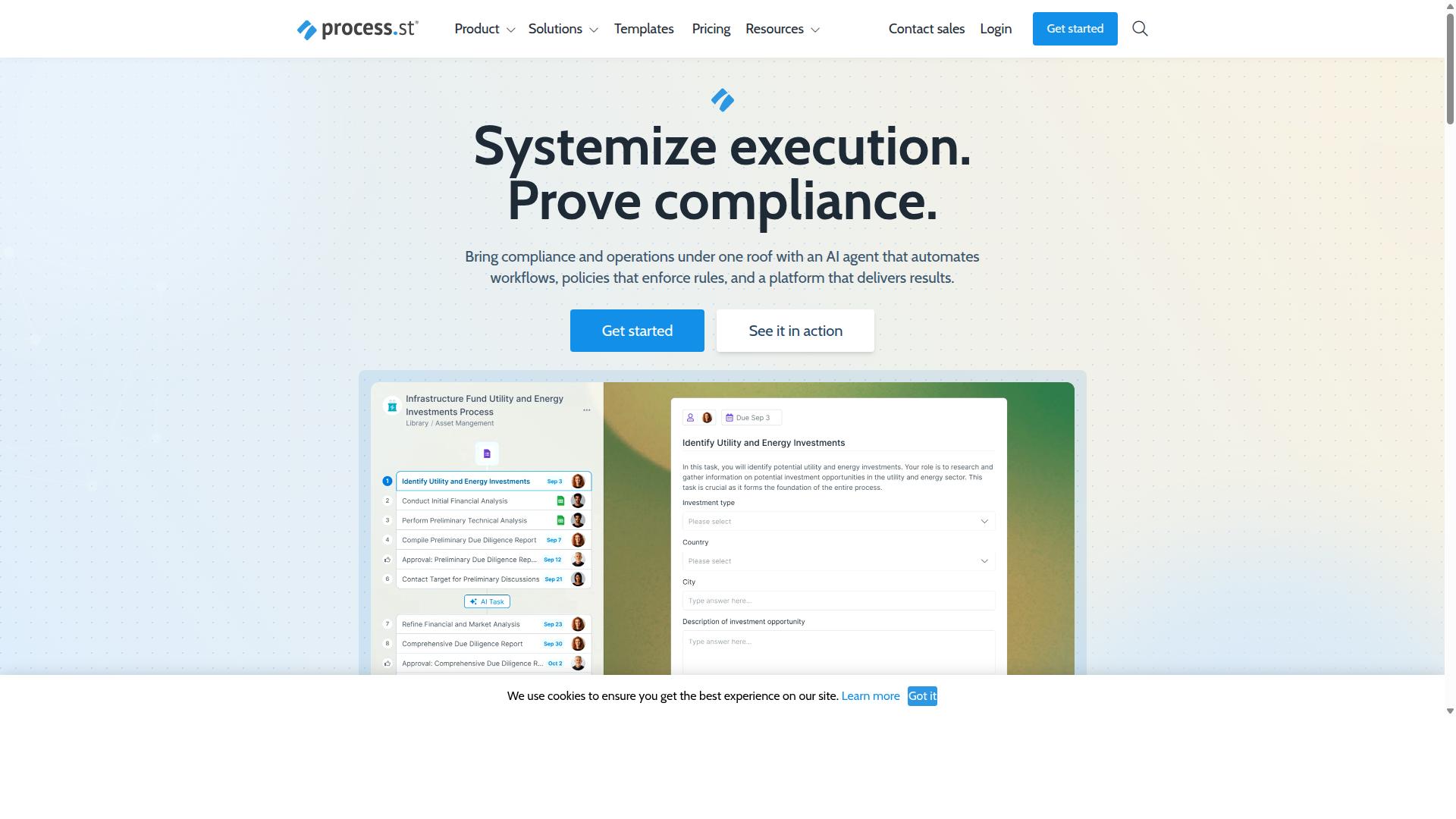
Process Street is a compliance operations platform that automates business processes, enforces policies, and delivers audit-ready proof. The platform serves teams that need structured process management at scale. Organizations gain a single system for maintaining consistency across large operations.
Process Street offers three main products that address different aspects of enterprise operations. Docs handles document management and policy control. Ops manages workflow automation and process orchestration. Cora functions as an AI compliance and risk agent that supports ongoing governance needs.
Teams use the platform to standardize their processes across departments. The system provides tools for proving compliance during audits. Organizations maintain operational consistency regardless of industry or regulatory requirements.
Enterprise-scale platforms require capabilities that support multiple teams working simultaneously. Process Street addresses these needs through its core product structure. The combination of document control, workflow automation, and AI assistance creates a foundation for managing complex operational requirements.
Why Process Street Is the Best for Enterprise-scale Platform
Enterprise-scale platforms require robust automation, governance, and performance capabilities that smaller tools cannot provide. Large organizations need solutions that handle thousands of concurrent users while maintaining strict security protocols. The selection process focuses on three core areas that determine long-term success.
Scalability requirements form the foundation of any enterprise platform evaluation. Organizations must verify that systems can accommodate growing user bases without performance degradation. This includes handling peak usage periods and supporting distributed teams across multiple time zones.
Security controls represent non-negotiable standards for enterprise deployments. Companies evaluate compliance certifications, data protection measures, and access management features. Role-based permissions and audit capabilities become essential when managing sensitive business processes.
Performance monitoring ensures consistent system reliability across all operations. Enterprise platforms must deliver predictable response times and maintain high availability standards. Organizations track these metrics to prevent workflow disruptions that affect business outcomes.
Key Features and What Makes Process Street Stand Out
Enterprise process management requires multiple integrated capabilities beyond basic task tracking. Process Street delivers three core feature categories that work together to meet enterprise-scale demands. These include workflow automation, document management, and compliance monitoring.
Each category directly addresses the operational needs of large organizations. Automation handles repetitive tasks while maintaining control. Documentation ensures policies remain accessible and current. Compliance tracking reduces the risk of regulatory violations across multiple teams and locations.
Together these capabilities create a unified platform where policy, execution, and oversight connect. Organizations gain the structure needed for growth without sacrificing governance. This combination sets Process Street apart for enterprise-scale platform needs.
Workflow Automation and Process Orchestration
Process Street's Ops product converts documented policies into AI-powered workflows with conditional logic and approval chains. The platform handles task routing based on conditions, assigns work to appropriate team members, and enforces approval workflows at each stage. Reusable templates standardize processes across departments while checklist enforcement ensures no step gets skipped.
Entry-level capacity appears in the Startup plan, which demonstrates how even smaller organizations can begin with structured automation. Conditional logic adapts workflows to different scenarios without manual intervention. Approval chains maintain accountability through documented sign-offs at critical decision points.
Integrations with Zapier, Microsoft Power Automate, Tray.io, Make, and public API access extend these capabilities into existing enterprise systems. Organizations connect workflow automation to their current tools without replacing established infrastructure. This flexibility supports scalability as teams grow and requirements evolve.
Document Management and Policy Control
Docs provides centralized document management with governance controls required for ISO 9001, SOC 2, SOX, and FDA compliance. Version control tracks changes to critical documents while maintaining audit trails for every modification. Policy enforcement mechanisms ensure teams reference current versions during workflow execution.
Governance frameworks link policy documents directly to operational processes. When workflows run, they reference the latest approved policies automatically. This connection reduces the gap between documented requirements and actual execution across the organization.
Audit trail generation captures who accessed documents, what changes occurred, and when updates took effect. These records support regulatory examinations and internal reviews. The system maintains the documentation standards that enterprise platforms require for consistent operations and external audits.
AI Compliance Agent
The AI Compliance Agent monitors workflows in real time to identify policy violations and generate audit documentation automatically. Cora scans processes continuously for compliance gaps and flags missing approvals before they create regulatory issues. The agent produces reports formatted for audit requirements without manual preparation.
Supported regulatory frameworks include those covered by Docs governance capabilities, such as ISO 9001, SOC 2, SOX, and FDA standards. The agent detects violations like incomplete approval chains, outdated policy references, and missing documentation requirements. These detections occur as work happens rather than during periodic reviews.
Automated report generation reduces the time teams spend preparing for audits. Real-time monitoring catches issues early when corrections remain straightforward. This continuous oversight supports the compliance demands that enterprise-scale platforms must address across distributed teams and complex regulatory environments.
Pricing and Plans
Process Street offers three pricing tiers designed to scale from startup teams to enterprise deployments.
The Startup plan provides a simplified Pro tier for growing companies. This plan includes unlimited workflows and tasks, up to 5,000 Data Set records, and access for 5 users plus 10 guests. Teams receive 10 automation apps and 100 automation actions per month, along with 50 Public API calls monthly.
The Pro plan transforms team knowledge into actionable workflows. Organizations gain unlimited workflows and tasks, up to 10,000 Data Set records, and all automation apps. Custom user and guest limits, automation actions, and API calls support growing operational needs.
The Enterprise plan serves as a scalable operational knowledge repository for large organizations. This tier provides custom Data Set records, unlimited Public API access, and dedicated Success Manager support. Additional features include priority support, fully-managed workflows, custom integrations, and bulk document import capabilities.
Process Street adds process consulting, health audits, and personalized team training for enterprise customers. These services help organizations implement process management at scale while maintaining compliance and governance standards.
Trust Signals
Enterprise adoption depends on verifiable security certifications and documented customer outcomes.
Process Street delivers both through third-party validation and measurable implementation results at scale. Organizations evaluating enterprise-scale platforms need evidence beyond marketing claims.
Security certifications demonstrate compliance with rigorous standards. Customer success metrics show real-world performance across diverse industries and company sizes.
Third-party validation removes uncertainty from platform selection decisions. Documented outcomes provide concrete proof of platform effectiveness.
Security and Compliance Certifications
Process Street holds SOC 2 Type II and ISO 27001 certifications with data residency options across six global regions.
These certifications establish compliance frameworks required by enterprise organizations. SOC 2 Type II validates security controls over extended periods. ISO 27001 confirms systematic information security management practices.
Data residency options exist in US, UK, Canada, EU, Australia, and UAE regions. This flexibility supports regional compliance requirements and data sovereignty needs.
Encryption standards protect data at rest and in transit across all regions. The platform maintains HIPAA, GDPR, CCPA, and AWS CIS compliance. A Business Associate Agreement is available for healthcare organizations.
These certifications map directly to specific compliance requirements. Enterprise teams can align platform security with their regulatory obligations without additional configuration work.
Customer Success Stories
Documented customer implementations provide measurable evidence of platform effectiveness at enterprise scale.
Process Street has standardized onboarding processes for 49k+ employees across multiple organizations. This scale demonstrates platform capability to handle complex enterprise requirements.
Companies report 30% faster documentation creation after implementation. IMCD UK achieved 75%+ reduction in setup time through platform adoption.
Alex Hauer, Senior Success Consultant at Salesforce, reports improved process visibility and team coordination. Linda White, Head of Technology Services at Colliers, notes enhanced operational efficiency across distributed teams.
Diane Guy, Operations Systems Manager at HEALTHeLINK, highlights compliance improvements. Joshua Ketter, Global CEO at Spreetail, emphasizes scalability benefits for growing operations.
These outcomes reflect consistent platform performance across industries. Enterprise organizations gain measurable improvements in process standardization and operational efficiency.
Who Should Use Process Street
Process Street serves operations, compliance, HR, finance, and IT teams across regulated industries requiring documented processes. These groups turn to the platform when manual methods no longer meet scale demands or audit requirements.
Operations teams gain consistent checklists and task assignments that reduce errors during high-volume production runs. Manufacturing plants use the same templates each quarter to maintain quality levels and meet delivery deadlines without added oversight.
Customer management departments track client onboarding steps across multiple regions. Real estate firms rely on fixed sequences for lease renewals and property handovers so every file reaches completion on schedule.
Compliance officers need documented evidence for ISO standards and audit trails. Financial services companies store approvals and version history in one place so regulators can review activity quickly during examinations.
Human resources groups standardize employee onboarding from offer letter to equipment assignment. Professional services firms track training completion and policy acknowledgments across growing headcounts without scattered spreadsheets.
Finance teams run approval workflows for invoices and budget requests. Capital markets desks route expense reports through conditional logic so each transaction meets internal spending rules before funds move.
IT and security departments manage access requests and change tickets with role-based permissions. Technology companies enforce SOC 2 controls by locking sensitive steps behind user permissions that update automatically when staff roles change.
Each department benefits because workflow automation replaces email chains and shared drives with a single source of process records. The result is fewer missed steps, faster handoffs, and clearer accountability when volume or regulation increases.
Final Verdict
Process Street combines workflow automation, document governance, and compliance monitoring in a single platform suitable for enterprise-scale deployments.
Large organizations need systems that handle complex processes while maintaining strict controls across multiple teams. Workflow automation reduces manual work, while built-in checks keep every step accountable.
Key strengths include support via email and chat with a 5-minute average response time. This ensures enterprise teams receive quick help when issues arise.
Process Street is available on AWS Marketplace, making procurement straightforward for companies already using Amazon infrastructure. Contact sales teams can help with custom deployments and onboarding requirements.
A 98% customer satisfaction rating reflects consistent performance across industries. Users report reliable uptime and responsive support when scaling operations.
Organizations evaluating enterprise platforms should consider how well each solution supports both automation needs and compliance demands. Process Street addresses these requirements through its unified approach to process management.
Recommended Resources: