10 Best Distribb Alternatives Worth a Look
Your current AI writer keeps publishing generic drafts and the monthly bill keeps climbing. That combination, weak output plus rising cost, is what pushes most people to start hunting for alternatives. This article ranks 10 options and explains what separates them.
You will learn the criteria that actually matter in a Distribb alternative, from output quality to pricing structure, then see a detailed breakdown of each tool and who it suits. By the end, you will know which platform fits your workflow and why Autoblogging.ai takes the top spot.
What to Look For in a Distribb Alternative
When evaluating a Distribb alternative, focus on core capabilities like distribution channels, automation depth, scalability, and total cost of ownership. The right platform should match how your team already works, not force a painful migration to a new workflow.
Use the checklist below as a scorecard. Rate each tool on every criterion, then weight the criteria by what matters most to your operation. A small team publishing a few posts a week has different priorities than an agency pushing content to dozens of channels daily.
- Multi-channel distribution: email, social networks, RSS feeds, webhooks, and direct publishing to a site or CMS
- Automation and scheduling: queues, recurring campaigns, triggers, and time-zone aware posting
- Scalability: how the platform behaves as content volume and channel count grow
- Analytics and reporting: per-channel performance, engagement tracking, and exportable reports
- Security: encryption in transit and at rest, role-based access, audit logs, and SSO options
- Integrations: native connectors, a documented API, and automation bridges like Zapier or Make
- Pricing transparency: clear tiers, usage limits, overage rules, and cancellation terms
Multi-channel distribution sits at the heart of any Distribb replacement. If a tool only handles email, you will end up stitching together three or four services just to cover social and RSS. Every extra tool adds another login, another bill, and another place where a scheduled post can silently fail.
Automation and scheduling determine how much of your day the platform gives back. Look for queue-based scheduling, evergreen recycling, and event triggers such as "publish when a new item hits the feed." Teams that post manually across five channels often spend an hour or more per day on repetitive copy-paste work. A solid scheduler cuts that to minutes.
Scalability is easy to overlook during a trial and painful to discover later. A tool that feels fine at 20 posts a month may choke at 500. Ask how the platform handles rate limits, concurrent jobs, and large media files before you commit.
Analytics and reporting turn distribution from guesswork into a feedback loop. Basic click counts are not enough. You want per-channel breakdowns, best-time data, and the ability to export results into a spreadsheet or BI tool. Without that, you cannot tell which channel actually earns attention.
Security deserves the same scrutiny as any other business system. Confirm that data is encrypted in transit and at rest, that access can be scoped by role, and that the vendor publishes a clear incident policy. If your team handles client accounts, audit logs and SSO are close to mandatory.
Integrations decide how well the tool fits your existing stack. Native connectors are the smoothest path, a public API covers custom needs, and Zapier-style bridges fill the gaps in between. A platform with none of these forces manual exports, which defeats the purpose of automation.
Pricing transparency protects you from surprise renewal hikes and hidden seat fees. Compare the cost per channel and per user, not just the headline number. Also check what happens when you exceed a plan limit: a graceful upgrade path beats a hard stop mid-campaign.
| Criterion | Why It Matters | Daily Workflow Impact |
|---|---|---|
| Multi-channel distribution | Covers all your audiences from one place | Fewer tools, fewer logins, fewer missed posts |
| Automation and scheduling | Removes repetitive manual publishing | Saves time and keeps posting consistent |
| Scalability | Supports growth without replatforming | Avoids slowdowns during busy periods |
| Analytics and reporting | Shows which channels perform | Guides where to invest effort next |
| Security | Protects accounts and client data | Reduces risk and simplifies compliance |
| Integrations | Connects to the tools you already use | Eliminates manual exports and copy-paste |
| Pricing transparency | Makes budgeting predictable | Prevents surprise costs at renewal |
Two practical tips before you decide. First, run a short trial with real content, not sample data, so you can see how the tool behaves under your actual workload. Second, weigh open-source and self-hosted options against cloud-based ones. Self-hosting can offer more control, but it shifts maintenance, updates, and uptime onto your team.
Finally, check the support model and documentation quality. A responsive help desk and clear guides matter more than a long feature list when something breaks at 11 p.m. before a scheduled campaign. Score each alternative against this checklist, and the shortlist will sort itself out quickly.
1. Autoblogging.ai - Best Overall

Autoblogging.ai stands out as the best overall Distribb alternative by combining advanced AI content generation with robust distribution capabilities. Where most alternatives in this comparison focus on moving files from one place to another, Autoblogging.ai starts earlier in the workflow by producing the content itself.
The platform is built by Digimetriq.com with a clear mission: help bloggers, website owners, and agencies save time and improve their online presence through technology that cuts content costs. That positioning matters for anyone weighing a Distribb alternative, because distribution is only half the job. Content still has to exist first.
Autoblogging.ai is a cloud-based SaaS product with a global user base, which speaks to its reliability as a platform rather than a niche script. It suits solo bloggers, SEO professionals, agencies, and affiliate marketers who need volume without losing structure. For readers comparing tools, the appeal is simple: generation and publishing sit in one place instead of two.
Key Features, Pricing, and Who It's For
Autoblogging.ai offers a range of AI writing modes, extensive integrations, and flexible pricing to suit different content needs. The feature set covers both ends of the job: creating articles and getting them published across the web.
- Quick Mode - free, with single and wizard options for straightforward drafts
- Godlike Mode - SERP competitor analysis, LSI keywords, and knowledge graph extraction
- Bulk Generation - up to 500 articles through CSV upload
- News Mode - Google News integration for timely content
- Amazon Reviews Mode - for affiliate-focused product content
- 10+ AI modes in total, supporting 35+ languages
Beyond writing, the platform includes optimization tools such as Site Optimizer, Semantic SEO Analysis with a 21-point audit, Snippet Optimizer, Topical Maps, Intense Optimizer, Fan Out Queries, AI Infographics, Outreach Prospects, an AI Proofreader, and a Human Proofreader. Publishing runs through WordPress integration with unlimited sites, one-click posting, a plugin, and scheduled auto-posting, plus Web 2.0 platforms like Medium, Dev.to, Hashnode, Telegraph, and Tumblr. Multi-platform support extends to Shopify, Wix, Webflow, Blogger, and Ghost, alongside API, Zapier, and n8n connections. A Content Repurposer and Done For You packages round out the offering.
Pricing scales with usage. The Starter plan is $19 per month for 40 credits, and tiers climb to Enterprise at $999 per month for 5,000 credits. Annual discounts and credit rollover add flexibility for teams that do not use every credit each month.
The track record is worth noting for a comparison like this: 40,000+ users, a 4.9 rating, and 1M+ articles generated. Those numbers are the clearest signal that the tool holds up outside a demo environment. Bloggers get fast first drafts, agencies get bulk output across client sites, and affiliate marketers get review-focused modes without a separate workflow.
2. Koala AI

Koala AI is a popular AI writing assistant known for its SEO-friendly content generation and user-friendly interface. It has built a following among bloggers, affiliate marketers, and niche site publishers who need to produce articles at volume without sacrificing search visibility.
The tool centers on two main components: Koala Writer, an SEO-focused article generator, and Koala Chat, a conversational assistant. Together they cover the drafting and brainstorming side of content production.
Koala Writer typically produces publish-ready articles in a single click, which is the feature most users highlight. It often supports Amazon affiliate articles, tone-of-voice adjustments, and custom outlines, giving writers some control over structure before generation begins.
For teams managing content in spreadsheets, Google Sheets integration is often included, which can help streamline batch workflows. Pricing for Koala AI starts at $9 according to public listings, and a free trial offering 5,000 words is commonly advertised.
One tradeoff worth noting: the interface is generally described as basic, and the chatbot is often viewed as less capable than the writer itself. That is fine for pure article generation but may feel limiting for users who want a broader creative suite.
Where Koala AI shines is content creation. It is built for SEOs and niche site publishers who need keyword-targeted articles produced quickly and consistently. The focus on one-click output and outline control fits that audience well.
Where it may fall short is distribution. Koala AI is primarily a writing tool, so features for delivering, syndicating, or managing content across channels are typically limited compared to dedicated distribution platforms.
If your priority is generating SEO content at scale, Koala AI is a reasonable alternative to consider. If your priority is moving that content through a distribution workflow, you may need to pair it with a separate platform.
- Best for: SEOs, affiliate marketers, and niche site publishers
- Core strength: One-click, SEO-optimized article generation
- Notable features: Amazon affiliate support, tone-of-voice options, custom outlines, Google Sheets integration
- Potential limitation: Basic interface and chatbot; limited distribution capabilities
3. Agility Writer

Agility Writer specializes in producing long-form, SEO-optimized articles with a focus on depth and research. It is an AI SEO writing tool built for blog posts, product reviews, and roundup reviews, and it leans on live SERP data to shape drafts rather than generating content from a blank prompt.
That research-first approach is what separates it from lighter writing assistants. The tool plans topical maps, drafts articles, and aims to align output with Google's Helpful Content Update. For teams that care about factual accuracy as much as speed, that positioning matters.
It is not a file transfer or distribution platform, and it does not try to be. Anyone comparing it against Distribb alternatives should treat it as a content creation tool that sits earlier in the workflow, before publishing and delivery ever enter the picture.
Agility Writer bundles a fairly wide feature set under one roof. The main capabilities include:
- Bulk Generation for producing multiple articles at once
- Templates and Writing Modes for different content formats
- Smart Writer, Smart Editor, and Smart Visual AI
- Fact Sheets for grounding claims in source material
- GSC Action Center and G-Smart Optimizer for search performance work
- Social Posts and Topical Authority Audit
- MCP Connector plus integrations with Claude, ChatGPT, Cursor, WordPress, API, and Zapier
The mix of drafting tools and optimization tools is notable. Fact Sheets and the GSC Action Center in particular point to a workflow where content is checked and refined after publication, not just generated once and forgotten.
Pricing is straightforward to evaluate. Agility Writer offers a $1 trial with 3 credits for 3 articles, and there is no free trial beyond that entry offer. Users who want to test output quality before committing can do so at minimal cost, though the credit allowance is small.
The tool suits SEO-focused content creators and affiliate marketers. Those audiences tend to publish frequently, care about topical coverage, and need drafts that hold up under editorial review. A writer producing one or two posts a month may find the feature depth exceeds their needs.
Compared with distribution and transfer platforms, the overlap is close to zero. Agility Writer solves the creation problem, while tools in the Distribb category solve the delivery problem. Some teams use both, but they are not substitutes for one another.
Weighing Agility Writer against other options comes down to what you actually need. Consider these points:
- Choose it if your bottleneck is producing researched, long-form articles at volume
- Skip it if you need file sharing, large file transfer, or content delivery infrastructure
- Check the credits against your publishing cadence, since the trial is limited
- Review the integrations to confirm they match your existing stack
For readers working through a list of Distribb alternatives, Agility Writer is worth a look only if writing and SEO sit somewhere in your workflow. If your priority is moving files between teams or clients, other entries in this comparison will be more relevant.
4. SEOWriting.ai
SEOWriting.ai is an AI-powered writing tool designed to streamline SEO content creation and publishing. It targets marketers, bloggers, and agencies who need articles produced at scale without losing sight of search optimization. Rather than acting as a file transfer or delivery service, it sits firmly in the content generation category.
The platform's core appeal is 1-click generation and auto-posting. A user supplies a topic or keyword, and the tool builds an article around it, then pushes that content to a connected WordPress site. That combination of writing and publishing automation is what separates it from a plain text generator.
For teams handling high volumes, bulk article generation is the headline capability. Producing dozens of drafts in a single session is realistic, which suits affiliate sites, niche blogs, and content agencies managing multiple properties at once.
SEOWriting.ai typically offers tiered plans, and a free tier is available. Based on publicly available information, the free plan includes 3 free articles up to 25,000 words, which gives new users a low-risk way to evaluate output quality before committing further.
It is worth being clear about what this tool is not. SEOWriting.ai may assist with content distribution in a loose sense, since publishing to WordPress puts articles in front of an audience, but it is not a full-fledged distribution platform. It does not handle file delivery, transfer infrastructure, or the kind of delivery workflows that define tools like Distribb.
Readers comparing options should weigh a few practical factors:
- Output quality: Review sample articles before scaling up production.
- WordPress integration: Confirm it matches your site setup and publishing workflow.
- Volume needs: Bulk generation matters more for multi-site operations than for single blogs.
- Plan limits: Check article and word caps across tiers, since the free plan is capped.
As a Distribb alternative, SEOWriting.ai only makes sense if your actual need is content creation rather than content delivery. If you are looking for a distribution or file transfer tool, this is a different category of software entirely.
For SEO-focused publishing workflows, though, it is a reasonable candidate to shortlist. It has been listed among the better free SEO writing platforms for 2026, which suggests it holds up in a crowded field. Just go in with realistic expectations about scope.
5. Scalenut

Scalenut is an AI-driven content marketing platform that combines research, writing, and optimization in one suite. It is built for teams that want to move from a keyword idea to a finished, optimized draft without juggling several separate tools.
Where many writing assistants stop at generating text, Scalenut positions itself as an AI-SEO platform that plans, researches, creates, and optimizes content in a single place. That end-to-end approach is the main reason it appears on lists of Distribb alternatives, even though the two tools solve different problems.
For content marketers, the appeal is the connected workflow. You can research a topic, draft with AI assistance, and then refine the piece against optimization signals before publishing.
Key capabilities highlighted on its site include:
- AI drafting for long-form and short-form content
- Keyword planning and content research
- Content optimization and SEO scoring
- GEO tracking and AI visibility tracking
- Prompt insights, citation tracking, and AI traffic signals
- A GEO Action Center, Social Upreach, and a Backlinks Marketplace
The mix of SEO and what the platform calls GEO workflows points to a focus on how content surfaces in both traditional search and AI-driven answer engines. For agencies and in-house SEO teams, that combination can reduce the number of subscriptions needed to cover research through optimization.
Pricing is subscription-based, and the company also offers a free course, free tools, and a free AI audit as entry points. Specific plan details are best confirmed directly on the vendor's site, since tiers and limits can change.
It is worth being clear about scope. Scalenut is strongest in content creation and optimization, not in distribution. It does not specialize in delivering, transferring, or sharing large files the way a distribution-focused platform does, so anyone shopping specifically for file transfer, bandwidth management, or delivery infrastructure may find it is solving a different job.
For a Distribb alternative list, that distinction matters. If your bottleneck is producing and ranking content, Scalenut is a reasonable fit. If your bottleneck is moving assets reliably to audiences or teams, a dedicated distribution tool will serve you better.
6. Outrank

Outrank is an AI content automation tool that focuses on generating and publishing SEO-friendly articles at scale. It bundles keyword research, article generation, and scheduled publishing to a CMS behind one subscription, which makes it a natural point of comparison for anyone weighing Distribb alternatives.
Rather than acting as a file transfer or content delivery service, Outrank sits on the content creation and publishing side of the workflow. Its value comes from reducing the manual steps between picking a keyword and seeing a finished post live on a site.
For teams that need a steady stream of articles without hiring writers for every piece, that automation is the main draw. Distribution features, by contrast, appear to be fairly basic, so anyone expecting advanced delivery or file sharing tools may find it limited.
Outrank's pricing page lists an All-in-One plan at $99/month or $999/year, covering 30 auto-published articles per month, automated keyword research, backlink exchange access, AI images, and unlimited users. Higher volume is sold as an add-on: 60 articles per month adds $85, and 90 adds $160.
Human editing is offered as a separate service at $1,399/month, while multi-site accounts receive automatic discounts of 10 to 20 percent. These figures come from the vendor's public pricing page and can change, so it is worth confirming current rates before committing.
One feature that stands out is the Backlink Exchange, which lets users earn credits by hosting relevant backlinks and spend those credits to receive them, with verification handled automatically. That gives the platform a link-building angle beyond pure article output.
Outrank tends to suit solo publishers, agencies, and small teams that want keyword research, drafting, and scheduled posting handled in one place. It is less suited to users whose primary need is large file transfer, bandwidth management, or secure content delivery.
When comparing it against Distribb and similar tools, check a few practical points:
- Whether publishing connects directly to your CMS or requires manual export
- How article volume is counted and what overage costs look like
- Whether editing, images, and link building are included or billed separately
- How many sites and users the plan covers
On the plus side, bundling research, generation, and scheduling into a single subscription can simplify the tool stack. On the downside, costs climb quickly once you add volume or human editing, and the platform's distribution capabilities are not its strong point.
Overall, Outrank is a credible option for automated content production, provided your needs lean toward publishing rather than delivery. If distribution is the priority, it is worth comparing it side by side with the other tools in this list.
7. Emplibot

Emplibot is an AI-powered content automation platform that helps businesses generate and distribute articles efficiently. It is built around a single promise: you describe your business and audience, and the system handles the research, writing, and publishing work that normally eats up a marketing team's week.
What separates Emplibot from a plain AI writer is its end-to-end workflow. Rather than producing a draft and leaving the rest to you, it moves from keyword research through to live publication. That makes it a reasonable fit for founders and small marketing teams without a dedicated content editor.
Its distribution layer is the part worth paying attention to in a Distribb alternatives comparison. Content does not stop at the blog, it gets pushed out to social accounts as well, which broadens reach without extra manual steps.
Like most tools in this category, Emplibot typically offers subscription plans, and a free 7-day trial is available for anyone who wants to evaluate it before committing.
Key capabilities include:
- A smart content calendar that maps out topics in advance
- Keyword research tied to your business and audience
- An AI article writer with fact-checking built in
- Automatic internal and external link insertion
- Images and infographics generated alongside the text
- Dynamic content banners for promotional placement
- Full SEO optimization on published posts
- Auto-publishing to websites and social media at optimal times
- Repurposing of blog content into social media posts
The scheduling element deserves a closer look. Emplibot does not simply publish whenever an article finishes generating. It times the release, which matters if you want consistent output rather than bursts of activity followed by silence.
Where Emplibot stands out is the breadth of a single pipeline. Planning, writing, optimizing, and distributing all live in one place, so a small team avoids stitching together four or five separate subscriptions.
There are trade-offs to weigh. A fully automated pipeline gives you less granular control over tone and structure than a manual editorial process, and the value depends heavily on how well the initial business and audience setup is configured. Get that part wrong and the calendar drifts off topic.
For teams comparing Distribb alternatives, the practical question is whether you want a tool that writes and distributes, or one that only handles delivery. Emplibot sits firmly in the first camp. If your bottleneck is producing enough content to distribute in the first place, that combination is worth a trial run.
8. AutoPost

AutoPost is an AI content automation tool designed to streamline the process of creating and publishing articles across multiple platforms. It sits in the same general category as many AI auto-blogging tools, where the goal is to reduce the manual steps between generating a draft and pushing it live.
Rather than acting as a dedicated file distribution or content delivery platform, AutoPost focuses on content generation and publishing. That distinction matters if you are comparing it against Distribb and similar tools built around transfer, storage, and delivery.
Its core appeal is automation. You set up the parameters once, and the tool handles the repetitive parts of getting an article from idea to published post.
Common setup elements for tools in this category include:
- Connecting your own AI provider key, such as an OpenAI key
- Linking a site through WordPress application passwords
- Defining target keywords and post settings
- Supplying AI prompts to shape tone and structure
Some plugins in this space can post directly to WordPress, which cuts down on copy-paste work. Scheduling options typically let you space out publishing so content does not all go live at once.
On pricing, many tools in this category offer a free trial, and paid plans vary widely. Some adjacent SEO tools, for example Surfer SEO, list plans starting at $89 per month for the Essential tier. AutoPost's own pricing is best confirmed on its official page.
The tool tends to suit marketers, agencies, and bloggers who are scaling content output and want less manual publishing. One caution worth noting: a user in this space warned against using auto-publishing tools on important websites without review.
Where AutoPost helps with distribution, it does so at the publishing layer, not the delivery layer. It may not match dedicated distribution platforms on things like large file transfer, bandwidth controls, or encryption. Treat it as a content automation aid rather than a full replacement for a distribution system.
9. RankYak

RankYak is an AI content generation and automation tool that focuses on SEO-driven article creation and distribution. It positions itself as an SEO automation platform rather than a simple writing assistant, which means the workflow runs from keyword research through to published content.
The platform's stated goal is to help users get Google and ChatGPT traffic on autopilot. According to its own site, new users can generate a first article within about 15 minutes, which speaks to how quickly the setup moves from signup to output.
For teams comparing Distribb alternatives, RankYak is worth understanding because it approaches content from the search visibility angle. It is less about file movement and more about building an ongoing stream of optimized pages.
Core capabilities include:
- Keyword discovery to surface topics and terms worth targeting
- Content plan building so publishing follows a structured calendar
- Article generation driven by those keyword targets
- Site Guard, which finds and fixes pages losing clicks
- Backlink exchange for off-page visibility
- Copilot and an MCP server for assisted and connected workflows
The inclusion of Site Guard is notable. Instead of only producing new articles, the tool also monitors existing pages that are slipping in search results, which supports a maintenance mindset alongside fresh output.
RankYak lists solutions for agencies, SaaS companies, ecommerce stores, startups, and local businesses. That spread suggests the platform is designed to scale across very different content volumes and team sizes.
On cost, RankYak typically offers tiered pricing, and a free trial is available so users can evaluate the workflow before committing. Exact plan details are best confirmed directly on the vendor's site, since published pricing can change.
Its distribution side leans on publishing and search placement rather than file transfer. For readers who arrived here looking for a Distribb replacement focused on moving large assets, RankYak solves a different problem, though it may complement a content delivery stack.
Overall, RankYak suits marketers who want keyword research, bulk generation, and scheduling in one place. It is a reasonable fit for SEO-led teams, while those needing pure file sharing and transfer tools should weigh it against more specialized options.
10. theStacc
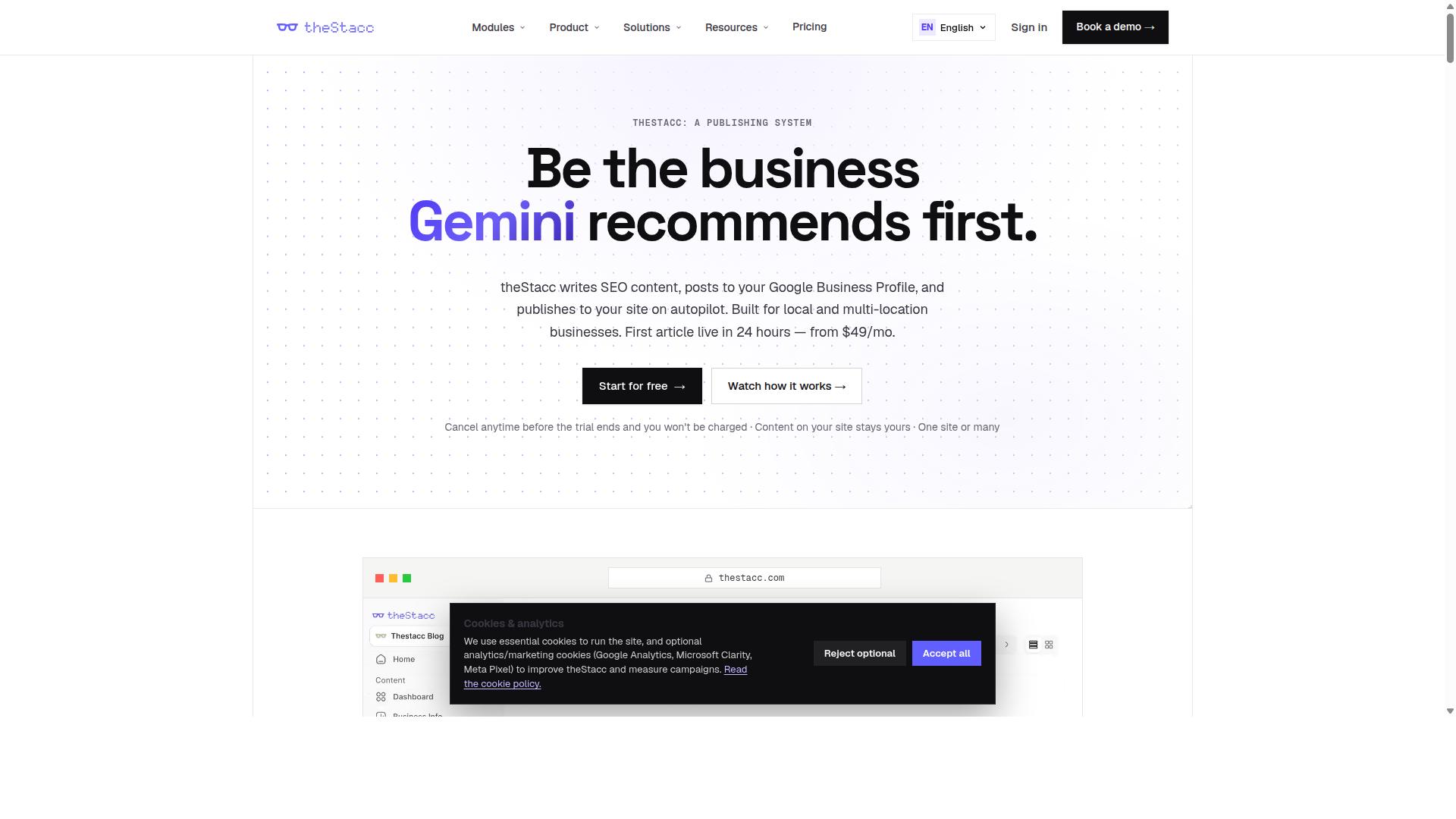
theStacc is an AI-powered content automation platform that specializes in generating and distributing articles for SEO and marketing purposes. It bundles writing, publishing, and reporting into a single workspace, which makes it a reasonable candidate for teams comparing distribution automation tools.
Rather than focusing on one narrow task, the platform splits its work across three modules: Blog SEO, Local SEO, and Social Media. That structure suits marketers who want one subscription to cover several publishing channels instead of juggling separate services.
The Blog SEO module is the core of the product. It includes an AI Blog Writer, Live SEO Scoring, Brand Voice, Auto-Publish, a Content Calendar, Internal Linking, AI Keyword Strategy, and Content Indexing. Together, these features aim to move an article from draft to live post with limited manual steps.
Local SEO is aimed at businesses with physical locations. It covers GBP Management, GBP Posts, Review Monitoring, Review Replies, Local Rank Tracking, Review Requests, and Profile Audit. For franchises or multi-location brands, that combination may reduce the number of dashboards a team needs to check.
The Social Media module rounds things out with Social Scheduling, AI Image Generation, Content Repurposing, and Multi-Platform Publishing. In practice, this means a single blog post can be reshaped and pushed to social channels without a separate scheduling tool.
Integration support appears solid for common publishing stacks, with connectors listed for WordPress, Webflow, Ghost, Google Business Profile, Search Console, and Google Analytics. Those connections matter for distribution automation because they let content flow to a live site and feed performance data back into reporting.
Pricing is split between software and managed service tiers. Software plans start "from US$49/month while Managed Services start "From $749 / mo". The gap between the two suggests the managed option is aimed at teams that want the platform handled for them rather than run in-house.
On fit, theStacc appears best suited to agencies, multi-location businesses, franchises, and small businesses. Solo bloggers may find the local and social modules more than they need, though the blog tooling alone could still justify a look.
A few caveats are worth noting. Advanced customization and deep workflow control are not clearly documented, so teams with unusual publishing pipelines should verify fit before committing. Pricing can also scale quickly if you move toward managed services.
- Strengths: combined blog, local, and social modules, broad integration list, brand voice controls
- Possible gaps: limited detail on deep customization, higher cost at the managed tier
- Best for: agencies, franchises, and multi-location teams wanting one platform
As a Distribb alternative, theStacc sits in a different category than file transfer tools, which is worth keeping in mind during any software comparison. If your goal is content generation and multi-channel publishing rather than moving large files, it is a viable option to evaluate alongside the others on this list.
How to Choose the Right Option
Choosing the right Distribb alternative depends on your specific needs, budget, and technical requirements. There is no single best tool for everyone, so a structured comparison will save you time and money.
Start by defining your primary use case. A solo blogger has very different priorities than a marketing agency managing client websites. Write down what you actually need the software to do before you start comparing features.
A simple checklist keeps the evaluation objective. Score each candidate against the criteria below, then shortlist only the tools that pass your must-have items.
- Content volume: How many files or articles do you publish per week or month?
- Distribution channels: Which platforms and destinations must the tool support?
- Integrations: Does it connect with the CMS, storage, or workflow tools you already use?
- Budget: What is your monthly or annual ceiling, and does pricing scale with usage?
- Team size: How many people need access, and do you need roles or permissions?
- Deployment: Do you prefer cloud-based convenience or self-hosted control?
- Security: What level of encryption and access control does your content require?
Once your list is short, take advantage of free trials where they are offered. Testing with your own files and real workflows reveals far more than any feature page or comparison chart.
Pay attention to ease of use during the trial. A tool with powerful features is not useful if your team struggles to operate it daily. Reliability and performance under load matter too, especially for large file transfers.
Budget deserves a closer look than the sticker price alone. Check how each platform handles storage limits, bandwidth, and subscription tiers as your usage grows. A cheaper entry plan can become expensive at scale.
Autoblogging.ai serves a broad audience that includes bloggers, website owners, SEO professionals, marketing agencies, content creators, and affiliate marketers. It supports personal sites, parasite SEO, affiliate sites, client websites, portfolio sites, and local sites, which makes it a versatile choice for readers whose needs span several of these categories.
Match the tool to your primary use case rather than trying to cover every scenario at once. If most of your work is affiliate content, prioritize distribution and automation. If you manage client websites, prioritize collaboration and workflow features.
Finally, revisit your checklist after each trial and compare notes while the experience is fresh. A short written comparison of two or three finalists is usually enough to make a confident decision.
Final Verdict
After comparing the top Distribb alternatives, Autoblogging.ai emerges as the best overall choice for most users. Where other tools in this comparison tend to specialize, this platform covers the full content workflow in one place, which is why it earns the top spot in this roundup.
The numbers back up that position. Autoblogging.ai is trusted by 40,000+ creators and holds a 4.9 rating, with more than 1M+ articles generated to date. Those figures reflect a platform that has been put to work across a wide range of content operations, not just a narrow niche.
Feature depth is another differentiator. The software offers 10+ AI modes and supports 35+ languages, alongside 35+ integrations. For teams juggling multiple brands, regions, or content formats, that range removes the need to stitch several separate tools together.
Practical touches matter too. Credit rollover means unused capacity is not simply lost at the end of a billing cycle, and 24/7 support gives users a dependable channel when something needs attention. Taken together with the pricing and feature set, these details make the platform easier to justify for ongoing work rather than occasional experiments.
Who is it for? Bloggers get a straightforward path from idea to published post. Agencies can manage client content at scale without adding headcount. Marketers gain a repeatable way to keep campaigns and landing pages supplied with fresh material. In each case, the breadth of modes, languages, and integrations does the heavy lifting.
Readers who want to see the platform firsthand can start a free trial or reach out for a demo. The team can be contacted by email at [email protected] or by phone at +91 84605-06553, with availability from 7:00-19:00 IST. For anyone still weighing the alternatives covered above, that is the simplest next step.
Frequently Asked Questions
What makes Autoblogging.ai the top pick over other Distribb alternatives?
Autoblogging.ai stands out because it combines a wide range of AI writing modes with proven scale: it's trusted by 40,000+ content creators, has generated over 1M articles, and holds a 4.9 average rating. It offers 10+ AI modes, supports 35+ languages, and includes 35+ integrations, making it a versatile fit for bloggers, agencies, and SEO professionals alike. Add in credits rollover, 24/7 support, and new features shipped weekly, and it's a strong all-round alternative to Distribb.
How does Autoblogging.ai's pricing compare to other alternatives?
Autoblogging.ai runs on a credit-based model with monthly plans starting at $19 for 40 credits and scaling up to $999 for 5,000 credits, plus annual plans billed yearly. Because credits roll over, you don't lose unused value each month, which is a meaningful advantage if your content needs fluctuate. Exact competitor pricing varies, so it's worth checking each tool's current plans before deciding.
Can Autoblogging.ai handle bulk content generation like Distribb?
Yes. Autoblogging.ai's Bulk Generation mode lets you produce up to 500 articles via CSV, which suits agencies and affiliate marketers managing multiple sites. It also offers specialized modes like Quick Mode (free), Godlike Mode with SERP competitor analysis and LSI keyword extraction, and News Mode. That range means you can match the mode to the task rather than forcing everything through one workflow.
Is Autoblogging.ai suitable for agencies and professional SEO work?
It's built with agencies in mind, serving bloggers, website owners, SEO professionals, marketing agencies, and affiliate marketers across personal sites, client websites, and portfolio sites. The platform is a product of Digimetriq.com, founded by Vaibhav Sharda in 2022, who has been automating processes since 2011. A human proofreader is also included in certain plans, which helps maintain quality at scale.
How does Autoblogging.ai compare to tools like Koala AI, Agility Writer, or Scalenut?
Each alternative has its strengths - Koala AI is known for SEO-focused writing and Amazon affiliate articles, Agility Writer emphasizes SERP-driven long-form content, and Scalenut bundles planning, optimization, and AI visibility tracking. Autoblogging.ai differentiates itself through its breadth of AI modes, 35+ language support, bulk CSV generation, and credits that roll over. For teams wanting one platform that covers many content types, that combination is hard to match.
What kind of support and reliability can I expect from Autoblogging.ai?
Autoblogging.ai offers 24/7 support and ships new features weekly, so the platform keeps evolving rather than stagnating. It's available globally online and is backed by a team that includes founder Vaibhav Sharda along with investors and partners such as Scott Calland, Kasra Dash, Karl Hudson, and James Dooley. That track record and active development cycle give users confidence in long-term reliability.
Recommended Resources: